
In this post, you will find formulas for moments of inertia of plane figures and how to apply these formulas when calculating the moment of inertia of figures composed of several simple figures.
- Moment of inertia of plane figures with respect to an axis (axial moment of inertia)
- Product of inertia of plane figures
- Formulas for moments of inertia of simple figures
- Sample task on calculating second moment of area
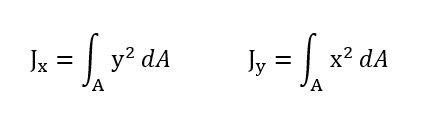
Moment of inertia of plane figures with respect to an axis (axial moment of inertia)
Axial moment of inertia of the figure we call the sum of the products of the elementary fields dA and the squares of their distances from this axis.
Product of inertia with respect to the axis system
The Product of inertia of the figure relative to the axis is called the sum of the products of the elementary fields dA and their distances from the axis. The Product of inertia is sometimes denoted by the capital letter D.

| If a figure has at least one axis of symmetry, the product of inertia of such a figure is zero. |
We can use the above formulas to determine moments of inertia of any figures from definitions using integrals. In this post, however, I would like to address how to calculate moments of charge of figures using formulas for simple figures without using definitions and integrals. You will encounter tasks of this type very often.
To use this method we will use Steiner's theorem. You can find more information about this method in this entry.
Formulas for moments of inertia of simple figures
In the figure below you will find the formulas for moments of inertia and moments of deviation of basic simple figures. The formulas in this table are sufficient to solve tasks where we have complex figures.
| Note that for a triangle and a quadrant of a circle, the sign of the moment of deviation depends on the orientation of the figure relative to the coordinate system |


Sample task on calculating second moment of area
The figure below shows a figure composed of a square, a triangle and a cut-out circle. For this figure, we will calculate the central moments of inertia and product of inertia.
| Try for free Moment of Inertia Calculator Create complex geometrical models composed of linear elements and compute their centroid and moment of inertia. |

Below are instructions for handling this type of task:
- Figure division into simple figures ( rectangles, triangles, circles...).
- Calculate areas and centers of gravity for these simple figures.
- Calculation of the center of gravity of the whole figure.
- Calculation of central moments of inertia and moments of deviation for all simple figures ( rectangles, triangles, circles...) we use the Fig.3
- Calculation of the central moments of inertia and the moment of deviation for the whole figure using the Steiner's theorems.
According to the above instructions for our example, we divide the figure into simple figures:
- A1 - quartz, A2 - triangle, A3 - circle.
We calculate the areas of the figures and their centers of gravity:
- x1,x2,x3 and y1,y2,y3
Next, we determine the center of gravity of the entire figure as described in this entry.

After calculating the figure's center of gravity, we proceed to calculate the central moment of inertia. We use the fig.3 and Steiner's theorems.

| Note that solid figures (square and triangle in our example) are added together in the calculation of moment of inertia and cut figures (circle in our example) are subtracted. |
In the next step we will calculate the principal central moments of inertia and the angle of rotation of the principal axes. General formulas and calculations for our example can be found below.

Finally, we create a drawing of our figure with the center axes plotted.

Summary
In this post, we presented key issues related to moments of inertia of plane figures. We discussed both basic definitions and practical ways to determine moments of inertia and moments of deviation for simple and complex figures. We pointed out how important Steiner's Theorem plays a role in calculations, which allows moments to be recalculated with respect to arbitrary axes using central values and the distance of the center of gravity from the reference axis.
The use of ready-made formulas and the ability to decompose a complex figure into simpler elements is invaluable in engineering, architecture or structural analysis. The ability to correctly determine the center of gravity and apply the appropriate formulas allows you to significantly simplify calculations and avoid errors.
Remember that any mass geometry problem can be solved step by step: from analyzing the figure, to dividing it into elements, to adding up their contributions to the total moment of inertia. Learning moments of inertia is a solid foundation in many technical fields!